
THE HEALTH TOLL OF IMMIGRATION
The Health Toll of Immigration
J. Michael Short for The New York Times
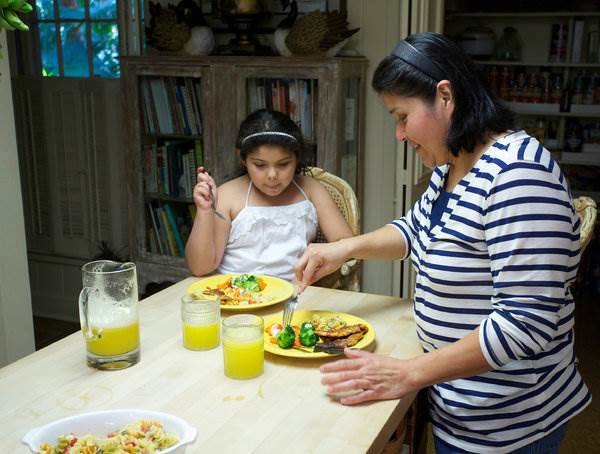
Esther Angeles, 41, with her daughter, Johanna Marisol Gomez, 7. Ms. Angeles has developed diabetes since coming to the United States and struggles to see that her daughter eats healthfully.
By SABRINA TAVERNISE
Published: May 18, 2013 74 Comments
BROWNSVILLE, Tex. — Becoming an American can be bad for your health.
Readers’ Comments
Share your thoughts.
Post a Comment »
Read All Comments (35) »
A growing body of mortality research on immigrants has shown that the longer they live in this country, the worse their rates of heart disease, high blood pressure and diabetes. And while their American-born children may have more money, they tend to live shorter lives than the parents.
The pattern goes against any notion that moving to America improves every aspect of life. It also demonstrates that at least in terms of health, worries about assimilation for the country’s 11 million illegal immigrants are mistaken. In fact, it is happening all too quickly.
“There’s something about life in the United States that is not conducive to good health across generations,” said Robert A. Hummer, a social demographer at the University of Texas at Austin.
For Hispanics, now the nation’s largest immigrant group, the foreign-born live about three years longer than their American-born counterparts, several studies have found.
Why does life in the United States — despite its sophisticated health care system and high per capita wages — lead to worse health? New research is showing that the immigrant advantage wears off with the adoption of American behaviors — smoking, drinking, high-calorie diets and sedentary lifestyles.
Here in Brownsville, a worn border city studded with fast-food restaurants, immigrants say that happens slowly, almost imperceptibly. In America, foods like ham and bread that are not supposed to be sweet are. And children lose their taste for traditional Mexican foods like cactus and beans.
For the recently arrived, the quantity and accessibility of food speaks to the boundless promise of the United States. Esther Angeles remembers being amazed at the size of hamburgers — as big as dinner plates — when she first came to the United States from Mexico 15 years ago.
“I thought, this is really a country of opportunity,” she said. “Look at the size of the food!”
Fast-food fare not only tasted good, but was also a sign of success, a family treat that new earnings put in reach.
“The crispiness was delicious,” said Juan Muniz, 62, recalling his first visit to Church’s Chicken with his family in the late 1970s. “I was proud and excited to eat out. I’d tell them: ‘Let’s go eat. We can afford it now.’ ”
For others, supersize deals appealed.
“You work so hard, you want to use your money in a smart way,” said Aris Ramirez, a community health worker in Brownsville, explaining the thinking. “So when they hear ‘twice the fries for an extra 49 cents,’ people think, ‘That’s economical.’ ”
For Ms. Angeles, the excitement of big food eventually wore off, and the frantic pace of the modern American workplace took over. She found herself eating hamburgers more because they were convenient and she was busy in her 78-hour-a-week job as a housekeeper. What is more, she lost control over her daughter’s diet because, as a single mother, she was rarely with her at mealtimes.
Robert O. Valdez, a professor of family and community medicine and economics at the University of New Mexico, said, “All the things we tell people to do from a clinical perspective today — a lot of fiber and less meat — were exactly the lifestyle habits that immigrants were normally keeping.”
As early as the 1970s, researchers found that immigrants lived several years longer than American-born whites even though they tended to have less education and lower income, factors usually associated with worse health. That gap has grown since 1980. Less clear, however, was what happened to immigrants and their American-born offspring after a lifetime in the United States.
Evidence is mounting that the second generation does worse. Elizabeth Arias, a demographer at the National Center for Health Statistics, has made exploratory estimates based on data from 2007 to 2009, which show that Hispanic immigrants live 2.9 years longer than American-born Hispanics. The finding, which has not yet been published, is similar to those in earlier studies.
Still, the data does not break down by generation. Ms. Arias cautioned that subsequent generations — for example, grandchildren and great-grandchildren — may indeed improve as they rise in socioeconomic status, which in the United States is strongly correlated with better health.
Other research suggests that some of the difference has to do with variation among American-born Hispanics, most of whom still do better than the rest of the American population. Puerto Ricans born in the continental United States, for example, have some of the shortest life spans and even do worse than whites born in the United States, according to research by Professor Hummer, dragging down the numbers for American-born Hispanics. But Mexican immigrant men live about two years longer than Mexican-American men, according to the estimates by Ms. Arias.
Why is a harder question to answer, researchers say. Some point to smoking. Andrew Fenelon, a researcher at Brown University, found in 2011 that half of the three-year life expectancy advantage that Hispanic immigrants had over American-born Hispanics was because they smoked less. The children of immigrants adopt health behaviors typical of Americans in their socioeconomic group. For second-generation Hispanics, the group tends to be lower income, with higher rates of smoking and drinking.
Other researchers say culture contributes. Foreign-born Hispanics are less likely than American-born Hispanics to be raising children alone, and more likely to be part of large kinship networks that insulate them from harsh American economic realities that can lead to poor health.
“I’d love to have my wife at home taking care of the kids and making sure they eat right, but I can’t afford to,” said Camilo Garza, a 34-year-old plumber and maintenance worker whose grandfather immigrated from Mexico. “It costs money to live in the land of the free. It means both parents have to work.”
As a result, his family eats out almost every night, leaving his dining table abandoned.
“It’s a decoration,” said Mr. Garza, who is overweight and a smoker. “It’s a place where we set groceries before sticking them in the refrigerator.”
The lifestyle takes its toll. The county in which Brownsville is situated, Cameron, has some of the highest rates of obesity and diabetes in the country. The numbers are made worse by a lack of physical activity, including walking. Immigrants said they felt so conspicuous during early attempts to walk along the shoulder of the roads that they feared people would suspect they were here illegally. Ms. Angeles recalled that strolling to a dollar store provoked so many stares that she felt like “a bean in rice.”
“In Mexico, we ate healthily and didn’t even know it,” said Ms. Angeles, who has since developed diabetes. “Here, we know the food we eat is bad for us. We feel guilty. But we eat it anyway.”
Still, immigrants have better health outcomes than the American-born. A 2006 analysis by Gopal K. Singh, a researcher at the Department of Health and Human Services, and Robert A. Hiatt, a professor of epidemiology and biostatistics at the University of California, San Francisco, found that immigrants had at least a 20 percent lower overall cancer mortality rate than their American-born counterparts.
Mortality rates from heart disease were about 16 percent lower, for kidney disease 18 percent lower, and for liver cirrhosis 24 percent lower.
“When my daughter was born, my doctor told me that if I wanted to see her 15th birthday I needed to lose the weight,” said Gerry Ortiz, 37, a first-generation Mexican-American in Brownsville. He managed to lose 75 pounds, motivated in part by his grandfather, a farmer in rural Mexico who at 93 still rides his bicycle every day. He stares down at the family from a black-and-white photograph hanging in Mr. Ortiz’s living room. Four of the family’s six siblings are obese and have diabetes.
And health habits in Mexico are starting to look a lot like those in the United States. Researchers are beginning to wonder how long better numbers for the foreign-born will last. Up to 40 percent of the diet of rural Mexicans now comes from packaged foods, according to Professor Valdez.
“We are seeing a huge shift away from traditional diets,” he said. “People are no longer growing what they are eating. They are increasingly going to the market, and that market is changing.”
Joseph B. McCormick, the regional dean of the University of Texas School of Public Health in Brownsville, said, “The U.S. culture has crept across the border.”
Perhaps more immediate is the declining state of Hispanic health in the United States. Nearly twice as many Hispanic adults as non-Hispanic white adults have diabetes that has been diagnosed, a rate that researchers now say may have a genetic component, particularly in those whose ancestry is Amerindian from Central and South America, Dr. McCormick said.
Hispanic adults are also 14 percent more likely to be obese, according to 2010 data from the Centers for Disease Control and Prevention. The rate is even higher for Hispanic children, who are 51 percent more likely to be obese than non-Hispanic white children.
“We have a time bomb that’s going to go off,” said Dr. Amelie G. Ramirez, a professor of epidemiology and biostatistics at the University of Texas Health Science Center in San Antonio. “Obesity rates are increasing. Diabetes is exploding. The cultural protection Hispanics had is being eroded.”
But at least for now, the older generation is still enjoying its advantage. In the De Angeles snack bar, a favorite meeting place for elderly Brownsvillians, one regular who is 101 still walks across the bridge to Mexico. Maria De La Cruz, a 73-year-old who immigrated to the United States in her 40s, says her secret is raw garlic, cooked cactus and exercise, all habits she acquired from her father, a tailor who died at 98.
“He had very pretty legs, like mine,” she said, laughing. “You want to see them?”
A version of this article appeared in print on May 19, 2013, on page A1 of the New York edition with the headline: The Health Toll of Immigration.
SO SAD



Asia Johnson was fatally shot Saturday night May 18,2013 on an MTA bus in Queens.
The teenager was shot in the head just after 9 p.m. while riding a Q6 bus on Sutphin Boulevard in Jamaica.
Police rushed her to the hospital, where she was pronounced dead.
The NYPD says a 14-year-old girl was shot and killed on a Queens MTA bus Saturday night.
The incident happened around 8:50 p.m. on board the Q-6 bus on Sutphin and Rockaway Boulevard in the Jamaica section.
Authorities say a male began firing shots into the bus and the victim was struck in the head. She was rushed to Jamaica Hospital where she was pronounced dead.
Police have made no arrests and their investigation is still ongoing.
Anyone with information is ask
Read more: http://www.myfoxny.com/story/22290566/fatal-city-bus-shooting-in-queens#ixzz2TkIOSOzE
BEYONCE ………….HUMAN ……….FINALLY






Beyoncé posted a message—which was quickly deleted from her Instagram—that criticized reports of her being pregnant with her second child with husband Jay-Z. What pics do remain are photos from her recent trip to Cuba to celebrate her fifth wedding anniversary. But of course the deleted message was seen by many, and saved, and it throws shots at the media.
The message that addressed the pregnancy rumors partly reads, “All I can do is sit back and laugh at all these low life people who have nothing better to do than talk about me.”
Ouch.
Needless to say one of Bey’s handlers probably told her that’s not the type of vitriol you should be sending the media’s way. Yesterday, E! Online reported that multiple sources confirmed that the singer was pregnant. The rumors of the bun in the oven caught fire when she arrived at the Met Ball wearing a Givenchy dress that hid her midriff, which in turn fueled all the speculation.
As for the photos of that controversial trip to Cuba, some of the flicks include a shot of her and some smiling children as well as one posing with her hubby. Check them all out, and the message she sent to the “low lifes,” in the gallery below.
There are no “do-overs” on the Internets.
—
Photos: Beyoncé, TMZ
– See more at: http://hiphopwired.com/2013/05/18/beyonce-shares-photos-of-cuba-trip-criticizes-pregnancy-rumors/#sthash.RQAPzUQN.dpuf
SEX WITH ANIMAL ADVOCATE TOLD TO STAY OFF THE WWW
 Sex-with-animals advocate told to stay off Internet
An unapologetic advocate of sex between animals and humans was warned by a judge on Friday that he’s flirting with violating the conditions of his release by having others post comments on the Internet for him.
By Mike Carter
A convicted drug-runner and unapologetic advocate of zoophilia — sex between animals and humans — was warned by a federal judge on Friday that he’s flirting with violating the conditions of his prison release by having others post comments on the Internet on his behalf.
Douglas Spink, 42, appeared before U.S. District Judge Ricardo Martinez in Seattle after concerns had been raised about Spink’s access to the Internet through third parties, including his mother. Spink allegedly had been having others post comments to websites affiliated with bestiality.
Spink is living with his mother after being released from prison after serving time for his 2005 arrest on drug charges. He was given a lenient, three-year sentence because of his extensive cooperation with investigators.
One of Spink’s attorneys, James Turner, of Bellingham, said his client believes that the controversy surrounding human-animal sex is shaping up to be the “civil-rights fight of the 21st century, much like gay rights.”
After the hearing, Spink said he’s misunderstood and maligned, and has never hurt an animal. He said he could sum up his philosophy in a single phrase: “Humans are not the only sexual species,” he said.
Martinez warned Spink that the court could do nothing about his ideas, “but I can control your actions.”
A representative of the U.S. Office of Probation and Parole said it appeared that Spink, who owned and operated a computer security company, was attempting to get around the court’s order that he avoid the Internet unless he agrees to having his computer use monitored.
Martinez told Spink that he understands that rules “chafe,” but that he must find a way to live within them or face another stretch in federal prison.
Earlier this month, the 9th Circuit Court of Appeals upheld Martinez’s decision to have the government wipe the hard drives of computers seized from Spink when he was arrested at his property in 2009 near Sumas at what Whatcom County officials have described as an animal-sex farm.
Spink was barely out of federal prison on drug charges at the time and the incident resulted in Martinez finding that he had violated conditions of his release by engaging in animal cruelty and eventually sending him back to prison for nearly three years.
Federal agents have been unable to access the hard drives, which they feared contained encrypted material related to bestiality.
The appeals court decided that it was better to be safe and wipe the drives than risk allowing Spink access to any hidden files.
A London man, Stephen Clarke, was also arrested at the Whatcom County property and pleaded guilty to animal-cruelty charges.
He testified that he had traveled from London to Spink’s property to have sex with Spink’s dogs and horses.
Police recovered several hours of videotape recordings of Clarke’s activities, according to court files.
Whatcom County officials waited until Spink was released from federal custody to a halfway house last year to charge him with three counts of animal cruelty in state court relating to the 2009 incident at the farm. Those charges are pending.
Meantime, Spink has 18 months of federal supervision remaining, and Martinez urged him not to mess up “when you’re this close.”
“Then you can be rid of us, and we can be rid of you,” the judge said.
Spink’s troubles began when his car was stopped in 2005 in Monroe loaded with 328 pounds of cocaine intended for Canada. Federal officials said the drugs were worth nearly $32 million, according to court documents. Spink could have faced up to 15 years in prison.
However, he agreed to cooperate and in exchange for his testimony against other drug suppliers and a pair of corrupt Seattle-area attorneys, Spink was given a three-year sentence.
Mike Carter: [email protected] or 206-464-3706
Information from Seattle Times archives is included in this report.
More Local News
Thurston County woman wins $75K for dog bite
More from our network
Wife repentant, but can marriage survive her unfaithfulness? From Seattle Times Living
Seattle man posted video before dying on highway From Seattle Times Local News
Edmonds police begin inquiry over Twitter photo of teens having sex From Seattle Times Local News
2 pit bulls enter Wash. home, kill cat From Seattle Times Local News
Pot rules taking shape; public gets a taste of what’s ahead From Seattle Times Local News
More from the Web
WTF AFRICA- GOBLIN IMPREGNATES WOMAN WHILE HUSBAND WAS AWAY…
 A WOMAN from Bezha in Gwanda surprised all and sundry when she told her South Africa based husband that she had been impregnated by a goblin.
The woman, Sihle Mpala, reportedly fell pregnant during her husband’s absence and when she was quizzed on the pregnancy, she claimed that goblins were responsible.
Michael Mthunzi revealed that he left his wife at his home two years ago and when he was away he got a phone call informing him to report home immediately.
“I received a phone call from my brother and we did not discuss much on the phone, he just told me that I should come home as soon as possible.
“I just thought that maybe someone at home had died therefore I arranged and came home,” said Mthunzi.
He revealed that when he got home, no one broke the news and his wife was absent.
“You know I was eager to know why I was wanted home with such urgency and when I realised that there was no funeral, I concluded that it was about my cattle.
“I then waited patiently for my wife, but when she got home I got shocked as I realised that she was pregnant.
“When I asked her what was happening, she told me that I should not beat her as she never cheated on me, but suspects that she was impregnated by a goblin,” revealed Mthunzi. He said his wife tried to convince him by telling him stories of goblins which were troubling villagers.
“In a bid to make me buy her story, she told me that there was a time when some men in the village woke up sleeping outside their bedroom huts. She made it appear as if goblins slept with their wives,” he said.
On the fateful day, Mthunzi became speechless and he just moved out of their bedroom hut to sleep in the kitchen.
He then confronted his family members on the matter, but they dismissed his wife’s claims saying she was trying to cover up for her actions.
“I told my wife that the best thing was to seek assistance from a traditional healer and find out the truth.
“Surprisingly, on the following day, we discovered that she had packed her belongings and that was a sign that she was telling lies,” he said.
Mthunzi’s brother also confirmed the incident saying they were still trying to find the whereabouts of Mpala as she did not go to her parents.

****RULES**** 1. Debates and rebuttals are allowed but disrespectful curse-outs will prompt immediate BAN 2. Children are never to be discussed in a negative way 3. Personal information eg. workplace, status, home address are never to be posted in comments. 4. All are welcome but please exercise discretion when posting your comments , do not say anything about someone you wouldnt like to be said about you. 5. Do not deliberately LIE on someone here or send in any information based on your own personal vendetta. 6. If your picture was taken from a prio site eg. fimiyaad etc and posted on JMG, you cannot request its removal. 7. If you dont like this forum, please do not whine and wear us out, do yourself the favor of closing the screen- Thanks! . To send in a story send your email to :- [email protected]
Recent Comments