JAMAICAN ARTIST A DI BEST OOO

The controversial artist known for “Scammer Anthem” who recently signed to a U.S based Recording Label called 5 Star Recording says the label had no interest in him as an artist whatsoever, and only wanted to use him to progress their label through other means. Stamma Gramma relieved himself of a one contract with the label today.
Statement from Stamma Gramma:
I have just relieved myself from a contract from 5 Star Recording Inc, ever heard of them? I know u have never…. So approx. a month ago, I signed to these ppl, and im not exaggerating, they have not done anything for me, not even a cd print, no strategies to direct my potential or anything, I swear I even had to put out their sign by myself. Whats even more disturbing, i heard the Ceo and all a dem staff which is equivalent to 3 ppl(joke thing) says they don’t support my music, they don’t like the image I put out and etc. Even more disturbing is that them say how I am a scammer, and me scam me way in the industry and it will backfire on me! So ppl me nuh know if a mad me a mad or something, then weh the bbc these ppl sign me for??? Can u believe your own so called team a talk abt u like that? Blatant Badmind!And point intended I did scam my way in the industry, the entry song was called scammer anthem . Others say they mad cuz they spent 6 years investing in an artist name Baby Chris, and I am more popular than this guy right now in space of a month. You know wats sad ppl, infront my face these ppl tell me, Im a super genius, im intelligent, I don’t need them cuz I do things for myself and a bunch of other warm comments and behind me back they hate me for all these things. The greatest evidence of them non interest in me was when they asked me to do website they day after I was signed, which wld take a month, clearly I wasnt signed as an artist, they wanted to sign my brain! A must that! Imma be real cuz u know me keep it real, I think them mad cuz I have more money than them and me nuh need them, its just sad how ppl hyprocitical.They say I cld’nt voice for no one else without them approval and them nah produce the songs I voice for them, jah know they was planning to stifle mi career.CRAB INNA BARREL!And all the frens of 5star who on my bbm,don’t give me nuh advice, I wont hesitate to tell unu f++ off!!!! No wonder why they broke, God don’t like ugly!!!
STAMPEDE AND DEM GINALSHIP…….READ OOO
U.S Based Dancehall Artist “Stylez” Feels Scammed By Promoter/Publicist Stampede
Rising artiste Stylez has been making significant strides since his entry into the music industry. The artiste whose fusion of dancehall and pop style resulted in coining the term “Poptois”, has been hard at work finishing his debut EP “Stylez And Hiz 6ix Diciplez” and investing in his own career by seeking out the right promotional team.
His latest collaboration “Rave All Night” featuring Ding Dong and Jr Pinchers, has resulted in a hit single who has entered the local and international charts as a contender for summer anthem. His uniqueness and artistry resulted in him opening for the likes of Grammy award Reggae Dancehall Artiste Beenie Man and, recently completed a North American tour with the “Energy God” Elephant man.
His career on track, Stylez has however become disenchanted by recent events with one of Jamaica’s well known Promoter/Entertainment Publicist. Stylez claims that Stampede of the popular Stampede Street Charts has defrauded him after securing his services to provide promotional media services. Stylez says that Stampede has not only failed to deliver months after being paid, but has then cut all contacts.
“Stampeded was referred to me by Mumzie but i was warned by others that if I am going to work with him I would have to use bruit force. I am a business man so I don’t have time for all that but if that’s what it boils down to I should have never engaged into business with him. I shouldn’t have to go and send man fi guh bad up no man fi services weh mi pay fah..” states Stylez
The artiste explains that after months of not receiving the services that was agreed upon and fully paid, and after being blocked and deleted from social sites such as twitter and facebook, he attempted to contact Stampede through various third parties.
“I am upset and feel disrespected and mi nuh tek dis. Mi nuh care who Di guy business is business.. Mi reach out to him in all ways possible, text call Fb twitter etc and no response and this is a man that is always online posting and promoting and ridiculing people at the same dam time! How can a man saying one ting n a duh another? Fake people alone mi know do dat man!” says Stylez.
Suss Media founder Mumsie thereafter met with Stampede, “I set up a meeting with stampede in Kingston Jamaica in order to pay for services to be rendered for a client of Suss Media, after weeks and no return messages or calls Stampede then contacted the client and said he was taking his time but now months later and all now no refund or work has been done, not even a call or money returned.”
When asked why he decided to talk to the media, Stylez said “Because Mi run outa patience, god build mi wid nuff patience but him nuh bill mi wid Di fool fool mentality! Mi a ghetto Yute just like stampede, mi nuh have gold spoon inna mi mouth, mi have my daughter fi tek care of mi have bills fi pay and mi nuh know y pple tink cuz a man deh a foreign dem rich.. Ntn nuh guh suh people need fi overs that mi work hard fi wah mi have and it nuh fall offa tree suh a man fi respect dat! Anuh everybody deh a foreign a do drugs! People fi know bout Di scam”.
Stylez who is busy gearing up for his upcoming promotional tour in support of his “Stylez And Hiz 6ix Diciplez” EP has yet to decide if he will pursue this matter legally, but states that “I am upset not because of the money but because of the principle.. If yuh a real street Yute u know word and good name is bond and if u bruk dat u get F**K. I am running a company, I have a brand and a image that is being nurtured and groomed for the major markets so when my team and I set out and hire people to enhance our vision we expect to get just that. Nothing more nothing less.”
GAYS OVERRUNNING SCHOOLS……………IT DEH A JA

SHELDON WILLIAMS, Staff Reporter
Explicit homosexual behaviour by students at a Corporate Area high school has teachers on edge as they try to cope.
A number of teachers told our news team that the deviant behaviours of both male and female students continue to manifest at the institution, despite their disapproval.
“Boys show their penises to each other in classes, and girls usually ask for passes to be excused from their classes, so they can go do their thing,” a concerned teacher, who asked not to be named, said.
Teachers have attributed the conductand breakdown in heterosexual attraction to the segregation of boys and girls at the school in some forms.
“Boys and girls are put in separate classes. It is an ongoing experiment and to this day, no one has shown us any findings or results to say it’s working,” a seasoned teacher explained.
They say the ‘experimental programme’ was to ensure academic focus of the students but it has produced homosexual behaviour instead. “I think from they split the genders, we have more gays than anything else,” the teacher stated.
Another teacher revealed that the lesbian behaviour seems to receive leeway but the boys face a harder task of being accepted. “Dem (girls) will sit beside each other and hug up and we’ll think nothing of it, but the boys for the most part have to do their thing in hiding,” he said.
THE Weekend STAR was also told that a number of girls have been suspended after they were caught naked in compromising positions at a location near the school resource officer (SRO) office .
Teachers say females usually provide satis- factory excuses to obtain passes from the school administration which they use to leave the school compound. Once they have departed, they meet up at various locations to carry out certain acts.
“The students know how to manipulate the system. The SRO has caught them on more than one occasion at locations naked and smoking,” a teacher admitted.
When quizzed about the reaction of parents and guardians to the disclosure that homo- sexual behaviour is prevalent at the institution, we were told that only a small number express grave concern.
“One or two parents will have a grouse but nobody will stand up strong. We have a weak PTA,” one teacher remarked. THE Weekend STAR tried exhaustingly over a three-week period to obtain comment from the school principal, bu,t on each occasion, was given a different excuse why she was unable to speak.
However, several students interviewed were more than eager to share what they knew.
“Yes, it’s true. It happens among the grade-eight students go up,” a 10th-grade male student said.
When quizzed how have parents reacted to the disclosure, he said, “A meeting was held with the parents dem and they are saying they don’t care because it’s what they (students) choose.”
He also admitted that they are indeed segre-gated at the school.
The student also claims that only grade-seven students are exempted from the homosexual behaviour because “dem just come”.
Interestingly, a female student interviewed delayed her responses to our enquiry until a group of her schoolmates walked by her to maintain the confidentiality.
“Yes, homosexual behaviour gwaan a school especially among the girls dem, yuh wah hear dem inna the bathrooms. They are also on Facebook on a page they created. Dem come back come chat who a get bun, and who a tek who fah girl.”
Another female student admitted that she has never witnessed any homosexual behaviour but admitted to being exposed to hearsay.
A grade-eight female student and her mother, however, told our news team that they were unaware of the homosexual claims.
Meanwhile, an 11th-grade male student reached into his pockets and removed some badges which he showed our news team.
“This is why I don’t wear my badges on road anymore because of the homosexual ting linked to the school. Thank God mi a leave school this year,” he said.
Meanwhile, Sheryl Bromfield, acting director of communications at the Ministry of Education, was contacted on numerous occasions, and told our news team that she would have to make contact with the deputy chief education officer for the school.
However, after five weeks of follow-ups, our news team has still not received any feedback.
DRY EYE TERRORIST
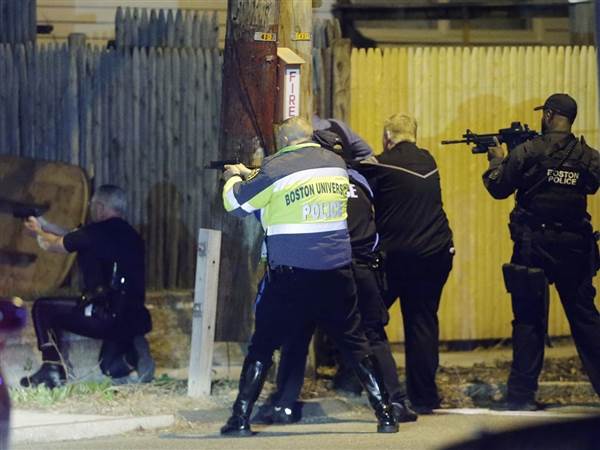
A 27-year-old man whose legs were blown off by the Boston bombings reportedly helped FBI agents identify one of the suspects, saying the man looked him in the eye as he placed a bag filled with explosives at his feet.
Jeff Bauman was waiting for his girlfriend to cross the finish line just before 3 p.m. Monday when a man wearing a cap, sunglasses and a black jacket dropped a bag at Bauman’s feet, his brother, Chris Bauman, told Bloomberg News.
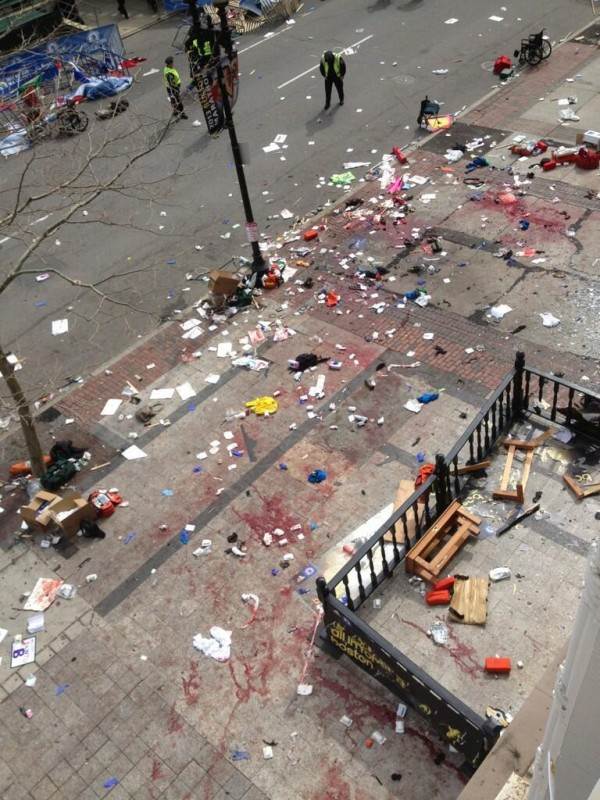
Two and a half minutes later, the bag exploded, shredding Bauman’s legs. A photo of his bloodied body being rushed by wheelchair from the scene has become an iconic image of the terrorist attack.
“He woke up under so much drugs, asked for a paper and pen and wrote, ‘bag, saw the guy, looked right at me,'” Chris Bauman told Bloomberg News.
Bauman’s description to investigators at his bedside reportedly helped them zero in on suspect Tamerlan Tsarnaev, who was killed early Friday in a shootout with police.
Bauman was rushed to Boston Medical Center, where both his legs were amputated from the knee down. His family learned of his fate only after seeing the grisly image of their son in news reports.
One volunteer, dubbed the the “Cowboy Hat Hero,” is being credited with helping to save Bauman’s life. The man, identified as Carlos Arredondo, used some pieces of cloth to tie tourniquets around Bauman’s mangled legs before getting him onto a wheelchair.
Arredondo’s son, Alex, died in Iraq in 2004. He was reportedly at the marathon to support “Tough Ruckers” – a group that runs in full military gear to honor fallen comrades.
Read more: http://www.foxnews.com/us/2013/04/19/bomb-victim-whose-legs-were-blown-off-reportedly-helped-fbi-id-suspect/#ixzz2Qv7Y2avR
BOSTON UPDATES
By Pete Williams, Richard Esposito, Michael Isikoff and Tracy Connor, NBC News
Boston and its surburbs, universities and transit system were on total lockdown Friday as police hunted for marathon bombing suspect Dzhokhar Tsarnaev — on the loose after his accomplice brother was killed in a stunning chain of events that left one cop dead and another injured, officials said.
Authorities were confronting a double-edged nightmare: a ruthless killer at large in a densely populated area and a four-mile stretch of road possibly littered with explosive devices tossed from the suspects’ getaway vehicle during a wild chase and firefights. An explosive was found in Boston and disabled, an official said.
A possible associate of the brothers was also being sought.
Advertise | AdChoices
Two unidentified people were taken into custody at the Cambridge, Mass., home where Dzhokhar Tsarnaev and his older brother Tamerlan grew up, but they were not being described as additional suspects. Three dozen FBI agents were surrounding the house.
NBC’s Lester Holt reports from Watertown, Mass., where Boston and state police, SWAT teams and a helicopter are engaged in a tense search for a suspect in the Boston Marathon bombing who is still at large.
Across the area, as police cars screamed down streets and helicopters hovered overhead, authorities urged the public to stay inside, their doors locked to anyone but law-enforcement officers.
“There is a massive manhunt under way,” Massachusetts Gov. Deval Patrick said. “We are asking people to shelter in place.”
The lockdown initially affected more than 300,000 people in Cambridge, Watertown, Newton, Brighton, Allston and Belmont, but by 8 a.m., the entire city of Boston was paralyzed, officials said.
Watertown, where the second suspect was last seen, was the epicenter of the search. Frightened residents were trapped in their homes as convoys of heavily armed officers and troops arrived by the hour.
Harvard University, Boston University, the Massachusetts Institute of Technology and Emerson University were all closed and students were told to stay inside. Boston public schools were shuttered for the day.
The overnight violence began near MIT about five hours after the FBI released surveillance photos of the two men suspected of planting two bombs near the finish line of Monday’s Boston Marathon, killing three and wounding 176.
Read more: Who are the brothers accused of the Boston Marathon bombing?
Tips about the identity of the suspects were still pouring in when the Tsarnaev brothers robbed a 7-Eleven then fatally shot MIT police officer Sean Collier, 26, in his vehicle at 10:20 p.m., law enforcement officials said.
The brothers — of Chechen origin, but legal permanent residents of the U.S. who moved here a decade ago — then carjacked a Mercedes SUV, holding the driver captive for a half-hour before letting him go at a gas station in Cambridge, sources said.
The suspects took off in the car toward Watertown, tossing explosive devices out the window, officials said.
Uncredited / AP
FBI photos of the Boston Marathon bombing suspects, brothers from the Chechen Republic. The man on the left is dead. The man on the right, Dzhokhar Tsarnaev, is still at large.
There was a long exchange of gunfire, Andrew Kitzenberg of Watertown, who took photos of the clash from his window and spread them on social media, told NBC News in an interview.
“They were also utilizing bombs, which sounded and looked like grenades, while engaging in the gunfight,” he said. “They also had what looked like a pressure-cooker bomb.
“I saw them light this bomb. They threw it towards the officers,” he said. “There was smoke that covered our entire street.”
A transit officer, identified as Richard H. Donahue, 33, was seriously injured during the pursuit. Authorities said he was in surgery at Mount Auburn Hospital.
Kitzenberg said he saw the firefight end when Tamerlan Tsarnaev ran toward the officers and ultimately fell to the ground.
Tamerlan— the man in the black hat from FBI photos released six hours earlier — had an improvised explosive device strapped to his chest, law enforcement officials said.
Dzhokhar — who was wearing a white hat in the surveillance photos from the marathon — drove the SUV through a line of police officers at the end of the street, Kitzenberg said.
Police said Dzhokhar has a Massachusetts driver’s license and lived in Cambridge. He was described as light-skinned and with brown, curly hair, and wearing a gray hoodie. The FBI was releasing more photos of him.
“We believe this man to be a terrorist,” Boston Police Commissioner Ed Davis said. “We believe this to be a man who’s come here to kill people.”
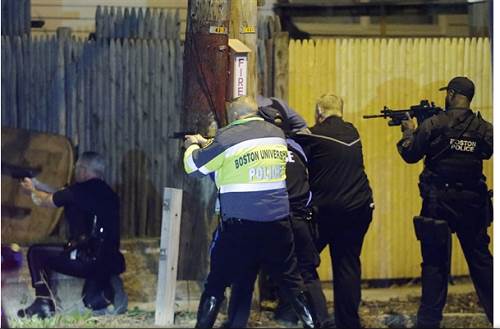
Armored humvees and busloads of law-enforcement could be seen rolling into Watertown in the hours after the gunfight. A photo showed two officers in military gear lying on a backyard shed with their weapons trained on a home.
“We’ve got every asset we could possibly muster on the ground right now,” Patrick said.
Advertise | AdChoices
Attorney General Eric Holder and FBI Director Robert Mueller headed to the White House to brief President Obama on the developments.
Slideshow:
BOSTON GI WI A LINK
Title: Boston bomber suspects
Message Body:
I am sooo scared now….the Boston bomber suspects were in my neighborhood…I heard loud boom noises,helicopter & nuff police sirens…I been up all night till now…they killed a MIT police, robbed a 7 eleven,& car jacked someone. We cant go anywhere…police & swat are all over the place..they said there might be active bombs on neighborhoods streets…scared bad….they are literally up the street
—
****RULES**** 1. Debates and rebuttals are allowed but disrespectful curse-outs will prompt immediate BAN 2. Children are never to be discussed in a negative way 3. Personal information eg. workplace, status, home address are never to be posted in comments. 4. All are welcome but please exercise discretion when posting your comments , do not say anything about someone you wouldnt like to be said about you. 5. Do not deliberately LIE on someone here or send in any information based on your own personal vendetta. 6. If your picture was taken from a prio site eg. fimiyaad etc and posted on JMG, you cannot request its removal. 7. If you dont like this forum, please do not whine and wear us out, do yourself the favor of closing the screen- Thanks! . To send in a story send your email to :- [email protected]
Recent Comments